
Spindles we rebuild
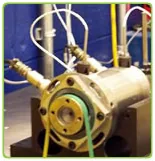
When a spindle fails, the fastest way back to production is a repair done right the first time. We repair, rebuild and recondition spindles for automotive, aerospace, military, tooling, machine tool, woodworking, plastics, stone, glass and ceramics applications — cartridge, block-style, belt-driven and motorized designs, including high-frequency and high-speed electrospindles.
We can rebuild a complete spindle or just the components you send, and we can make new parts when the originals can’t be saved.
What a rebuild includes
- Photos of the spindle as received and of every part after teardown and cleaning
- Electronic gauging of all critical surfaces
- Taper regrinding and rework, drawbar repair, collet repair or replacement
- Bearing seat and housing bore rework, hard chrome and grind, spacer grinding
- Motor repair and rewinding on motorized spindles
- Balancing of every rotating part, then of the assembly
- New bearings, correct lubrication, run-in, and checks for vibration, temperature and runout
- Final balance with the pulley or tool holder mounted, when applicable
Step by step
- Check-in. Each spindle gets a work order that travels with it through the shop, recording every finding and every operation. Before anything comes apart, we look it over for outside damage that could explain the failure.
- Teardown. Disassembly is done carefully, watching for contamination, lubrication breakdown or signs of a crash. Parts are cleaned, dried and lightly polished in a dedicated area.
- Inspection and failure report. Critical parts are measured for size, runout, alignment and parallelism. You get a written report on the likely cause of failure and what can be done to keep it from happening again.
- Machining and grinding. Our in-house machine shop reworks, remanufactures or makes new parts as needed. In a climate-controlled grinding room, CNC grinders hold ODs, IDs and internal and external tapers to 0.000025" TIR or better, and jig, center-hole, surface and rotary grinding hold tolerances to 0.000010". Keeping this work in-house protects quality and turnaround.
- Balancing. Unbalance shortens bearing life and leaves chatter on your parts. We balance each rotating component on computer-controlled balancing equipment, then balance the assembled spindle.
- Clean-room assembly. Experienced assemblers build the spindle in a dedicated clean room with new bearings and filtered lubricants. Our team brings decades of combined hands-on experience in grinding, boring, jig grinding, and lathe and CNC work.
- Run-in and test. The spindle is brought up to speed in stages in a clean test area while we monitor speed, vibration, temperature and runout. It has to meet or beat the original specifications before it ships. See our spindle test and analysis stand.
- Packing and shipping. If paint is needed, we match it. Spindles are wrapped in non-reactive material, cushioned in foam and shipped in heavy-duty cartons. Spindles of 125 lb or more ship in custom wooden crates.
Spindle types
- Ball bearing, roller bearing, hydrostatic and hydrodynamic spindles
- ID, OD, cylindrical and centerless grinding spindles
- CNC surface grinder, tool and cutter grinder, form and creep-feed grinding spindles
- Wheelhead, workhead and dresser spindles
- CNC milling, drilling, fine boring and lathe spindles
- Automatic tool change and coolant-through spindles with Morse, HSK, DIN, BIG-PLUS or Capto tapers
- High-speed router, molder and shaper spindles
- Engraving and PCB drilling spindles
Spindle down? Call (586) 795-5550 for a quote and turnaround time.